Dragon Tiger: Rules, Demo Play, and Real Money Betting

Updated for 2026 · Reviewed by the Casino and Betting India editorial team

Dragon Tiger is a fast two-card casino game. One card goes to the Dragon position, one to the Tiger position, and the higher card wins the round. It started life as a stripped-down alternative to baccarat in Asian gaming halls, and it has since spread across online platforms and live dealer suites. The reason is not mysterious: simple mechanics, quick rounds, and payout rules you can read in one screen.

Provider

Evolution

RTP

96.27%

Volatility

High

Min bet

$1.00

Max bet

$5,000

Max win

50x
Dragon Tiger Rules, Demo Play, and

Dragon Tiger in 30 Seconds

  • The rules take about ten seconds to learn. One card to Dragon, one card to Tiger. Higher rank wins. Ace is low (1), King is high (13), and suits are ignored for the main outcome.
  • Only two bets are mathematically defensible. Dragon and Tiger both pay 1:1 with a 96.27% RTP and a 3.73% house edge.
  • The Tie bet is the single biggest trap. At an 8:1 payout the house edge reaches 32.77%. Even the friendlier 11:1 schedule still costs 10.36%.
  • No strategy beats the math. Roadmaps, streak-reading, and Martingale progressions cannot change the fixed probability of one card draw.
  • Speed is the hidden risk. Live tables resolve up to 140 rounds per hour, so flat bets of 1%–2% of your bankroll and a hard loss limit are not optional extras.
Dragon Tiger in 30 Seconds

Origins and Cultural Symbolism of Dragon Tiger

Dragon Tiger is widely believed to have originated in Cambodia before spreading through gaming venues across Southeast Asia. The format later gained enormous traction in Macau, where high rollers were drawn to its rapid pace, minimal rule set, and near-coin-flip main bets. From Macau's floors it migrated into online live dealer lobbies, where it now sits alongside baccarat and roulette as a core table product.

The game's popularity rests not only on its tempo but on a deep cultural foundation. In Asian tradition, the Dragon symbolises prosperity, strength, and good fortune, while the Tiger represents courage, determination, and unshakeable authority. Placing these two legendary figures on opposite sides of the felt turns every round into a symbolic duel between two sacred creatures. That framing gives an otherwise minimal card comparison a bit of theatrical weight, and it explains why the game travels so well in India.

Regulatory documentation frames the game in far drier terms. Official rule sets published by the Gambling Regulatory Authority of Singapore define Dragon Tiger as a baccarat variant in which one face-up card is dealt to Dragon and one to Tiger, with the objective being to predict which side wins or whether the round ends in a Tie.

Origins and Cultural Symbolism of Dragon

«The objective of the game is to predict whether the Dragon or the Tiger will win, or whether there will be a Tie.» — Gambling Regulatory Authority of Singapore, Dragon Tiger (MBS) Game Rules. https://www.gra.gov.sg/docs/default-source/game-rules/mbs/other-games/dragon_tiger_(mbs).pdf

What Is Dragon Tiger and How the Game Works

Dragon Tiger is an online card game where you predict whether the Dragon hand or the Tiger hand receives the higher card value, or whether both cards match in rank for a Tie. It was designed as an ultra-fast casino title. Each round resolves in roughly 15 to 25 seconds, with no complex drawing rules and no multi-card combinations, which is why the game dragon tiger has become a staple of modern online casino live lobbies.

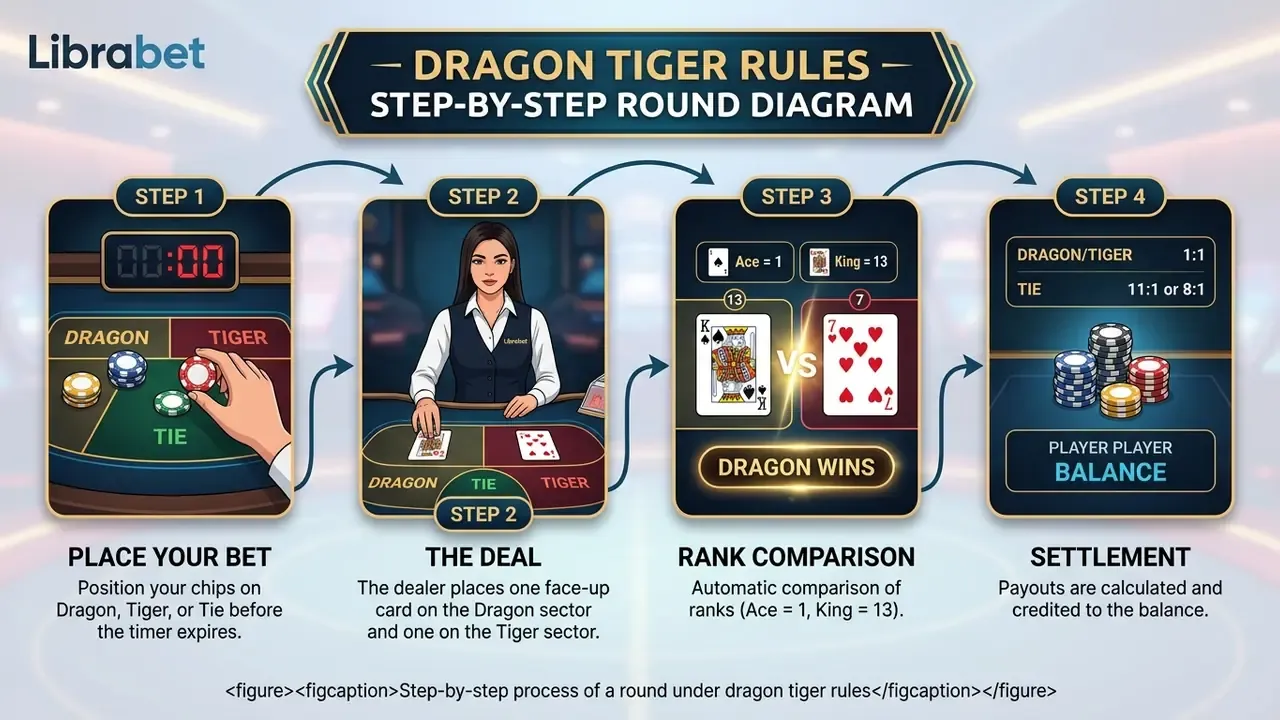
The dealer draws exactly two cards from a standard multi-deck shoe, typically six or eight 52-card decks with jokers removed. One card is placed face-up on the Dragon betting sector, and one face-up card goes to the Tiger sector. Suits are disregarded for the primary outcome. The winner is decided strictly by comparing the single numerical or face-card rank of the two positions.

What Is Dragon Tiger and How
dragon tiger rules - step-by-step round diagram

Dragon, Tiger, and Tie Bets

The core betting options centre on Dragon and Tiger. Both pay even money (1:1) and both win with equal probability on non-tie hands. A Tie occurs when the two sectors receive cards of identical rank, and it pays at longer odds such as 8:1 or 11:1, depending on the operator's payout schedule.

Because a Tie forces a partial loss, usually 50%, on main Dragon and Tiger wagers under standard casino rules, the main bets carry a house edge of roughly 3.73%. The standalone Tie bet is a different animal entirely: its house edge runs from 10.36% at 11:1 up to 32.77% at 8:1. High risk, and rarely worth it.

Dragon, Tiger, and Tie Bets. The

«At an 8:1 payout, the house edge on the Tie bet reaches 32.77%, among the highest figures found in any casino game.» — Panaloinfo, Dragon Tiger odds analysis. https://panaloinfo.com

Regulated rule sets confirm exactly how the partial loss works. Under the Marina Bay Sands Dragon Tiger rules filed with Singapore's regulator, Dragon and Tiger wagers lose 50% of the staked amount when a Tie is dealt, while standalone Tie wagers win. Renaissance-style variants published by other venues define the tie as an "i-Pair" requiring matching rank and suit. That single difference changes your expected return, so reading the in-game help file before your first stake is not optional.

The Dragon Tiger Phoenix Variation: A Three-Way Duel

Modern live studios, Evolution in particular, now offer an evolved format known as Dragon Tiger Phoenix. Instead of two competing positions, the dealer deals to three: Dragon, Tiger, and Phoenix. One face-up card goes to each spot, and the objective is to predict which of the three cards will be the highest.

Key differences of the Phoenix format:

  • Three positions. You wager on which of the three cards holds the superior rank, rather than choosing between two.
  • Complex tie outcomes. New payout scenarios appear when two of the three positions share a rank, or when all three cards match at once (a Triple Tie), which usually carries a dedicated high-odds wager.
  • Recalculated RTP. Because probability is spread across three outcomes instead of two, the theoretical house advantage is recalculated. A flat-betting player has to recalibrate unit sizing rather than assume the classic 3.73% figure still applies.

The change sounds minor. It is not. More possible outcomes mean higher variance per round, and streak patterns become even less meaningful than in the two-card original.

The Dragon Tiger Phoenix Variation A

How Dragon Tiger Differs from Other Casino Games

Dragon Tiger differs from blackjack, baccarat, and poker by removing player decision-making after the cards are dealt. Blackjack asks you to hit, stand, split, or double. Poker runs multiple betting rounds across several cards. Dragon Tiger has one decision point, and it happens before the draw.

Compared with baccarat, which uses strict third-card drawing rules and hand-sum calculations, Dragon Tiger uses only two cards per table round. That minimal setup lets live dealer platforms execute up to 140 rounds per hour, making it one of the fastest live casino experiences available online.

«Dragon Tiger Live completes a round in roughly 25 seconds, about 140 rounds per hour, nearly twice the speed of live baccarat.» — Pragmatic Play, Dragon Tiger Live product description (2020). https://pragmaticplaylive.net

CriterionDragon TigerBaccaratBlackjackPoker
Cards per round2 total4–64+ per hand5–7 per player
Player decisions in-roundNoneNone (fixed drawing rules)Multiple (hit/stand/split/double)Multiple betting rounds
Rule complexityMinimalModerateHighVery high
Rounds per hour (live)Up to 14060–8050–7020–40
Main-bet house edge3.73%1.06%–1.24%0.5%–2% (with strategy)Varies by format

Read that speed column twice. It is the reason a 3.73% edge hurts more here than a 1.06% edge does at a slow baccarat table.

Dragon Tiger Rules: Round Order and Determining the Winner

The official dragon tiger rules start each round with a timed betting window, followed by the deal of one face-up card to Dragon and one to Tiger. The position holding the higher-ranked card wins the main bet. Equal ranks trigger a Tie settlement.

Check the payout table and the side bet rules before you place a real money bet. Software providers such as Evolution, Pragmatic Play, Ezugi, Playtech, OnAir Entertainment, and VIVO Gaming apply subtle variations to tied hands and side wagers, and those small differences move the numbers.

Bet optionWinning conditionStandard payoutReturn to player (RTP)House edge
DragonDragon card outranks the Tiger card1:1 (50% returned on a Tie)96.27%3.73%
TigerTiger card outranks the Dragon card1:1 (50% returned on a Tie)96.27%3.73%
Tie (11:1)Dragon and Tiger cards share the same rank11:189.64%10.36%
Tie (8:1)Dragon and Tiger cards share the same rank8:167.23%32.77%
Suited TieBoth cards match in rank and suit50:186.02% – 87.07%12.93% – 13.98%
Big / SmallCard rank above 7 (Big) or below 7 (Small)1:1 (a 7 loses)92.31%7.69%
Red / BlackThe selected colour appears on Dragon or Tiger1:1 (a 7 loses)92.31%7.69%
Odd / EvenOdd or even card rank (Ace=1, J=11, K=13 odd; Q=12 even)1:1 (a 7 loses)92.31%7.69%
SuitCorrectly predicting the suit of the chosen position3:1≈92.3%≈7.7%

Provider rule sets diverge more than most guides admit. Some Ezugi and Playtech tables publish a Tie at 11:1 with Suited Tie at 50:1, while alternative configurations pay Tie at 6.5:1 and Suited Tie at 20:1, dropping side-bet RTP as low as 82.93%. Singapore's regulator has also approved a documented "No Commission Baccarat" Dragon Tiger variant effective 7 December 2023, which changes tie handling entirely. Open the paytable inside the specific table before your first stake.

Card Values and Comparing the Two Cards

In standard dragon tiger game card rankings, the Ace is lowest at 1, followed by 2 through 10, then Jack (11), Queen (12), and King (13) as the highest card. Spades, Hearts, Diamonds, and Clubs carry no weight in deciding the main winner between Dragon and Tiger.

Some provider variations flip this. Certain Pragmatic Play live tables rank Ace above King, with 2 as the lowest card. Review the in-game help menu to confirm card values, especially before touching side bets like Big/Small, Red/Black, or Odd/Even, where a 7 loses automatically for both categories.

«Of 86,320 possible two-card combinations in an eight-deck shoe, Dragon and Tiger each win 39,936 times, and a tie occurs 6,448 times.» — Wizard of Odds, Dragon Tiger odds guide (2024). https://wizardofodds.com

Those combinatorics are the whole foundation of the maths in the table above. A 7.47% tie frequency against a 46.26% win rate for each main side is what produces the 3.73% house edge once the 50% tie deduction is applied. Nothing about that shifts between one round and the next.

How to Place a Bet and Complete a Round

To place a bet, select your chip value in the interface and click your chosen betting sector, Dragon, Tiger, Tie, or an available side bet, before the on-screen countdown reaches zero. The table displays its permissible minimum and maximum limits before betting opens, and your balance must cover the stake for the bet to register. Once the timer expires, the dealer locks the layout and draws the cards.

The dealer places the cards on the marked sectors, and the optical scanning system reads the values instantly. Winning bets are credited automatically, losing chips are collected, and 50% of main bets are returned if a Tie occurs without a winning Tie wager. The result appears only after betting closes. Formally, the round runs from the "Place your bets" call to full settlement for every seated player.

How to Place a Bet and

E-E-A-T Rule Verification Check (Updated) Always verify the specific payout schedule in the live casino game menu before you deposit funds. The publicly filed Dragon Tiger game rules of the Gambling Regulatory Authority of Singapore confirm the 1:1 main-hand structure and list Tie at 11:1 with Suited Tie at 50:1 for the licensed venues covered by that document (https://www.gra.gov.sg/docs/default-source/game-rules/mbs/other-games/dragon_tiger_(mbs).pdf). Commercial operators outside that jurisdiction commonly cut Tie to 8:1 or 6.5:1, which directly alters your theoretical return. The payout badge on the table, not a third-party guide, is the authoritative figure.

Dragon Tiger Demo: How to Play Free Before Betting Real Money

A dragon tiger demo lets you explore the full game interface, test round timing, and watch outcome histories using virtual credits, with no real funds at risk. RNG-based 3D simulators such as Evolution's First Person Dragon Tiger mirror the exact math and payouts of the physical live tables. The virtual credits carry no monetary value and cannot be converted into cash or a casino balance.

Demo modes are a practical education step, and I would argue an underused one. You get complete freedom to evaluate the layout, test button responsiveness on a mobile browser, and understand rule nuances before making any deposit. Most RNG demos launch straight from the game lobby in a browser, without registration or an app download, though some operators require a logged-in account to open the free-play version of a licensed title. Worth checking before you plan a practice session.

Dragon Tiger Demo How to Play

«Players who began with social casino products before monetary betting more often used them for social interaction or to manage gambling urges.» — Study on social casino motives and gambling transitions, 228 participants. https://www.ncbi.nlm.nih.gov

What You Can Test in Demo Mode

In free-play mode you can practise placing bets inside simulated time limits, explore roadmap statistics panels such as Big Road, Bead Plate, Big Eye Boy, and Small Road, and watch how tie hands settle without financial consequences. First Person builds let you deal hands manually, control the pace, and build a trend history before committing anything.

Demo software also lets you test flat-betting models across hundreds of simulated hands. By tracking how the virtual balance moves, you can see for yourself how a 3.73% house edge grinds against long-term capital stability. It is slow, then it is obvious.

What You Can Test in Demo

«Participants who played demo modes with inflated RTP placed significantly higher bets when they switched to real-money play.» — Journal of Gambling Studies, laboratory experiment on slot demo modes (2015). https://link.springer.com/journal/10899

That finding is exactly why a demo session should be treated as a rules laboratory rather than a performance benchmark. A demo balance that grows is a statistical accident, not evidence of an edge.

How Demo Differs from Real Money Play

The real gap between demo play and real money play sits in three places: emotional control, live dealer presence, and financial outcome. Most live dealer tables do not offer free access, because a human croupier and a physical studio have to run in real time. That limits demo modes mainly to single-player RNG titles. Where a live table cannot be sampled for free, watching the stream without staking does much the same job. You learn the timer rhythm, the dealer's cadence, and the visual cues for settlement.

Research on simulated gambling flags a critical behavioural transition:

«Engagement with social casino and demo games is significantly associated with subsequent monetary gambling, including in longitudinal and randomised study designs.» — Report on the convergence of simulated and monetary gambling (2025). https://www.begambleaware.org

Risk-free wins lower a player's perceived risk when they move to real money platforms. That is precisely why the switch deserves a deliberate checklist instead of an impulse deposit.

[❓ QUIZ: Are you ready to move from demo to real money?]
Description: A four-question interactive self-check:
1. Do you understand that a Tie result costs 50% of your main Dragon/Tiger stake?
2. Can you explain why the house edge on the Tie bet is far higher than on Dragon/Tiger?
3. Have you set a fixed per-session loss limit in INR?
4. Have you checked the account verification (KYC) requirements and UPI/NetBanking withdrawal options?
Purpose: helps the user objectively assess readiness for real-money play.
Semantics: <section role="form" aria-label="Self-assessment quiz for real money dragon tiger play">.
Risk-free wins lower a player's perceived

Dragon Tiger Live Dealer: How the Live Casino Format Works

Dragon Tiger live dealer formats combine real physical card dealing with high-definition video streaming from licensed studios. Professional croupiers host the tables, and the format adds interactive chat, physical multi-deck shoes, and real-time card scanning.

Major studios such as Evolution, Pragmatic Play, Ezugi, and Playtech broadcast Dragon Tiger tables in 4K from purpose-built facilities. Pragmatic Play's Dragon Tiger Live, for instance, is streamed using 4K cameras, trained hosts, and modern audio engineering. Expect Asian-themed studio aesthetics and embedded digital roadmaps that track consecutive hand patterns. Readers comparing formats across the wider live casino platforms market will find the same core table replicated with different tie schedules and side-bet menus, which is exactly why the paytable check matters.

Dragon Tiger Live Dealer How the

How a Live Dealer Round Runs

A live round begins when the host calls for bets and the interface opens the betting window. Players pick their wagers while a 15 to 20 second timer counts down on screen.

Once bets close, the dealer draws one physical card from an eight-deck shoe for Dragon and one for Tiger, sliding each over optical scanner plates set into the table. The software verifies the scanned values, shows the winner, and settles every digital bet across all connected players at once.

Shoe management follows documented procedure. When the cutting card appears, the dealer announces "the last hand of the shoe," and no further cards are dealt until the full card-change or shuffle routine finishes. Pragmatic Play's published rules also mandate a card change at least once every 24 hours and after interruptions such as stream loss or a card with a defective barcode. That safeguard protects game integrity and gives any dispute review something concrete to examine.

How a Live Dealer Round Runs

Technical Requirements and Optimisation for Mobile Live Play

Playing Dragon Tiger on a phone or tablet, through a browser or an app, works best when a few conditions are met. Connectivity faults here cost money, not just patience.

  • Connection stability. A 4K/HD live stream needs roughly 10 Mbit/s of sustained bandwidth. Latency above 500 ms can make you miss the betting phase entirely, because virtual chips fail to register before the 15-second timer hits zero. Live streaming also eats far more mobile data than an RNG table, so watch a metered plan.
  • Touch UI. In mobile builds, the Rebet button and the roadmap panels (Big Road, Bead Plate) are optimised for single-thumb use. Turn on bet confirmation in the interface settings. It prevents accidental taps on high-edge sectors such as Tie, which is a genuinely common mistake at speed.
  • No download required. Evolution, Pragmatic Play, and Ezugi tables run directly in a mobile web browser, with the stream auto-scaling to the screen while keeping HD quality. A dedicated app is optional, not mandatory.
  • Session hygiene. Because the stream adapts quality to bandwidth, a degrading picture is an early warning of an unstable link. Closing the table before a full disconnection avoids ambiguous settlement situations and support tickets you did not need.
Technical Requirements and Optimisation for Mobile

What to Look at When Choosing a Dragon Tiger Live Casino

When you evaluate an online casino for live Dragon Tiger play in India, put regulatory status, payment processing, and clear terms ahead of anything cosmetic. Confirm that the cashier supports local channels like UPI, Paytm, or NetBanking without hidden conversion fees, and that the withdrawal page states a concrete processing window rather than a vague "up to" range.

Then inspect the bonus terms. Many welcome offers exclude live dealer titles from wagering, or cut their contribution to 5%–10%. A large promotional headline can therefore hold almost no real value for a dedicated Dragon Tiger player. Read before you claim, not after.

What to Look at When Choosing

Betting, Payouts, and Risk in Dragon Tiger

⚖️ Disclaimer: This information is general in nature and does not replace professional advice. Real-money play carries financial risk. Play responsibly: set loss limits, never stake essential funds, and observe the 18+ age requirement.

The financial structure of Dragon Tiger pairs simple even-money bets with volatile high-payout side options. Main bets give predictable returns. Long-term statistical analysis shows the alternatives carry steep margins that drain a deposit much faster than most players expect.

"Before you deposit real funds for any online casino session, evaluate the table rules and withdrawal conditions first. A simple game format like Dragon Tiger offers fast entertainment, but rapid round speeds mean your bankroll requires strict limits and full visibility on payouts." — Nisha Rao, Editorial Lead at Casino and Betting India

A mathematical proof published in 2025 on the long-term behaviour of casino games makes the ceiling explicit:

«A player's ratio of net gain to total stakes converges almost surely to the negative value of the house edge.» — arXiv preprint, Long-term behaviour of casino games (2025). https://arxiv.org/abs/2025

For Dragon Tiger online play, that confirms two things. No betting progression bypasses the 3.73% house advantage on main hands. And every extra round you stake pushes your realised result closer to that negative expectation, not away from it.

Main Bets and Payout Options

Main bets on Dragon or Tiger form the core of standard play, returning ₹1 in profit for every ₹1 wagered. Because either hand wins 46.26% of all deals, these are the lowest-risk options on the table.

Side wagers such as Suited Tie at 50:1 or Suit predictions at 3:1 add variance without adding value. A Suited Tie pays handsomely when it lands, but its probability is roughly 1.45% in an eight-deck shoe. That figure lines up with the combinatorial breakdown from Wizard of Odds, where 6,448 of 86,320 two-card combinations tie and only a fraction of those also match in suit. The result is a house edge above 13%. Big/Small, Red/Black, and Odd/Even sit at a uniform 7.69% edge for one specific reason: the 7 is treated as an automatic dealer win in those categories.

Main Bets and Payout Options. Main

Why Bet Size Matters for Your Bankroll

A live Dragon Tiger dealer runs 120 to 140 rounds every hour. Pragmatic Play publishes that figure for its own Dragon Tiger Live product, at roughly 25 seconds per round (https://pragmaticplaylive.net). Fast turnover exposes your bankroll to the house edge at an accelerated rate, and uncontrolled stake sizes can clear a session balance within minutes during an extended losing run.

When auditing user friction for Indian casino traffic, our editorial team looked at how fast stake limits affect play on mobile interfaces using UPI and NetBanking. In this internal, non-peer-reviewed editorial trial, presented as an illustrative observation rather than a verifiable statistical study, a test account starting with ₹5,000 under flat ₹100 bets sustained an average session of about 45 minutes. Aggressive progression betting emptied the same balance in under 8 minutes once consecutive ties appeared. Individual results will vary with table speed, tie frequency, and limits. But the direction matches the published maths: unit sizing controls your exposure time, not your outcome.

Why Bet Size Matters for Your

🚨 Alert Box: Real Money Play and Financial Limits Playing Dragon Tiger for real money does not guarantee profitable returns. All outcomes are governed by independent random probabilities. Set strict daily loss limits, never gamble with money reserved for essential living expenses, and make sure your chosen operator complies with local Indian regulatory guidelines on age verification (18+) and mandatory KYC checks. Regulatory frameworks such as the UK Gambling Commission's LCCP (section 3.3.1, 2026), the Danish Gambling Authority's responsible-gambling guidance, and PAGCOR's Responsible Gaming Code of Practice all require operators to provide deposit limits, session timers, reality checks, and self-exclusion tools. If your platform offers none of these, treat it as a red flag.

Dragon Tiger in India: Legality, KYC, UPI Payments, and Tax

⚖️ Disclaimer: The legal status of online gambling varies by jurisdiction. This article is not legal advice. Verify current rules with a qualified lawyer or on official regulator resources before depositing.

India's real-money online gaming environment is governed at the national level by MeitY guidelines and by the Promotion and Regulation of Online Gaming Act 2025 together with its 2026 Rules, layered on top of state-level statutes that differ sharply from one another. Several states impose their own restrictions on real-money play, and a platform accessible from one state may be prohibited in another. Because the framework is still consolidating, the practical obligation sits with the player: confirm the current position in your own state, and use only operators that publish licence details, a privacy policy, responsible-gaming caps, and a grievance-redress contact.

India's real-money online gaming environment is

Payment Methods for Indian Players: What to Compare

MethodTypical deposit speedTypical withdrawal windowNotes for Dragon Tiger players
UPIInstantSame day to 24 hours at most operatorsMost common rail; check whether the operator supports UPI for withdrawals as well as deposits
NetBankingInstant to 30 minutes24–72 hoursBank-to-bank trail; useful for larger sums but slower on reversals
Paytm / walletsInstant24–48 hoursConvenient on mobile; verify the wallet name matches your KYC name
AstroPay / prepaid vouchersInstantOften deposit-onlyAdds a layer of separation from the bank account, but check withdrawal eligibility
CryptoMinutesMinutes to hoursFastest settlement, but adds exchange-rate and compliance risk

Operator-published withdrawal times range from "instant" to 72 hours. Take the figure from the cashier page rather than a review site, and confirm whether the stated window starts before or after KYC approval. That detail alone explains a lot of "delayed payout" complaints.

KYC Verification Checklist

  • Identity proof: PAN card, Aadhaar, passport, or driving licence, legible, uncropped, and matching your account name exactly.
  • Address proof: a recent utility bill or bank statement, usually no older than three months.
  • Payment ownership: a screenshot or statement showing that the UPI ID or bank account belongs to you; third-party payments are almost universally rejected.
  • Age verification: documentary confirmation that you are 18 or older.
  • Verify before you win: complete KYC immediately after registration, not after requesting a withdrawal, to avoid multi-day payout delays.
KYC Verification Checklist. - Identity proof

Tax and Payment-Blocking Risks

Real-money winnings in India are subject to tax withholding at source (TDS) under prevailing income-tax provisions, and licensed operators may deduct it before releasing funds. Budget for that when you calculate net returns. A headline win is not a net win.

Equally important: unlicensed or grey-market sites materially increase the risk of failed or reversed payments, frozen balances, and blocked bank transactions, with no regulator to appeal to. Tax treatment depends on your personal circumstances, so consult a qualified tax professional rather than relying on operator statements.

Bonus Wagering: A Worked Example

Welcome bonuses are the most misread element of Dragon Tiger promotion terms, because live table games usually contribute only a fraction of their nominal turnover.

[🧮 BONUS CALCULATION BOX]

Bonus received:                ₹10,000
Wagering requirement:          30x bonus  =  ₹300,000 in qualifying turnover
Dragon Tiger contribution:     10%

Actual turnover needed at a live Dragon Tiger table:
₹300,000 ÷ 0.10 = ₹3,000,000 staked

At flat ₹100 bets that is 30,000 rounds.
At ~140 rounds per hour, that is roughly 214 hours of continuous play.
Expected loss at a 3.73% house edge on ₹3,000,000 turnover ≈ ₹111,900.

The conclusion is arithmetic, not opinion. A ₹10,000 bonus with a 30x requirement and a 10% live-game contribution costs far more in expected loss than it can ever return. Other traps to check in the terms:

  • Zero contribution. Many operators exclude live tables from wagering completely. A 0% contribution makes the bonus unclearable at Dragon Tiger.
  • Prohibited hedging. Covering both Dragon and Tiger at once to churn turnover is explicitly banned by most terms and is a standard ground for bonus confiscation.
  • Max cashout caps. A "₹10,000 bonus" often carries a maximum withdrawal of a small multiple of the bonus, however much you win.
  • Expiry windows. Requirements that must be met in 7 days are effectively impossible at sensible stake sizes.
Bonus Wagering A Worked Example. Welcome

Dragon Tiger Strategy: A Realistic Approach Without the Myths

No dragon tiger strategy removes the casino's structural house edge or predicts a single-card draw with certainty. Each deal comes from a shuffled multi-deck shoe, so the outcomes displayed on roadmap charts have no influence on the probability of the next hand.

«Analysis of more than 100,000 rounds on Evolution and Pragmatic Play tables confirmed outcome independence: the average Dragon streak length was 1.8 wins.» — Casinohacks, live-stream log analysis, Dragon Tiger hand tracking. https://casinohacks.com

Card counting fails structurally here too. One exposed card per side, settled immediately, from an eight-deck shoe, leaves no composition-dependent decision for a player to exploit. Promotional claims advertising "100% winning hacks" or guaranteed pattern predictors are simply false. Sensible play focuses on risk minimisation, bankroll management, and steering clear of high-margin side bets.

SystemHow it worksThe illusion of an edgeActual mathematical risk
MartingaleDoubling the stake after every loss"One win recovers every previous loss"High risk of rapid, large losses during long losing runs and on hitting the table maximum.
Roadmap readingHunting patterns on the display (Big Road, Bead Plate)"After four Dragon wins, Tiger must be due"Events are independent: card probabilities stay fixed regardless of history.
Flat bettingA fixed stake of 1%–2% of bankrollNo promise of fast profitOptimal risk control: minimises variance and extends session length.

The Martingale case is not theoretical. Simulation data quantifies it precisely:

«Over 1,000 simulated rounds at a $10 base stake, expected loss under Martingale and flat betting was identical at $373, but the peak required stake under Martingale reached $1,280.» — Betting-data-lab, Dragon Tiger betting systems simulation. https://betting-data-lab.com

So progression buys no reduction in expected loss at all. It only converts a slow, survivable drawdown into a small chance of catastrophic ruin in one sequence.

Principles of a Cautious Betting Approach

A sensible approach to Dragon Tiger is strict flat betting on the main Dragon or Tiger sectors, and nothing else. Wagering a fixed unit, usually 1% to 2% of your session bankroll per hand, protects the balance against sudden drawdowns from short-term variance. Conservative frameworks add two more rails: a session loss cap of roughly 20%–30% of the bankroll, and a pre-set win target that triggers an exit. Decisions get made before emotion enters the round.

Avoid Tie and Suited Tie wagers in standard sessions, along with Big/Small, Red/Black, and Odd/Even. Excluding those keeps your play exposed only to the lowest available operator advantage of 3.73%. And because a fast table multiplies bet count rather than bet size, capping rounds per session matters as much as capping stake per round. Set a timer if that helps.

Principles of a Cautious Betting Approach

Mistakes to Avoid in Dragon Tiger

The most frequent beginner mistake is chasing losses, either by switching to Tie bets or by applying progressive doubling. Fast rounds can push a Martingale player into the table limit or an empty wallet inside six consecutive losses. The sixth double of a ₹100 base unit already demands ₹3,200 on a single card comparison.

A second common error is treating tilt as a passing mood rather than a financial event. Guides consistently name "chasing losses with Tie bets" as the clearest behavioural marker of tilt in this game, precisely because the Tie sector sells the illusion of instant recovery at four to nine times the cost in expected value.

Another pitfall is ignoring regulatory context and safety checks. Under India's legal environment for real-money online gaming, shaped by MeitY guidelines and by the Promotion and Regulation of Online Gaming Act 2025 with its 2026 Rules, players should select compliant, transparent platforms that clearly publish privacy policies, responsible gaming caps, and a workable KYC verification flow before any deposit.

Mistakes to Avoid in Dragon Tiger

⚖️ Disclaimer: The legal status of online gambling varies by jurisdiction. This article is not legal advice. Verify current rules with a professional lawyer or on the official resources of the relevant regulator.

One last thing. Avoid content that confuses Dragon Tiger with a video slot. There are no reels, paylines, scatters, wilds, or free-spin rounds here. It is exclusively a card game, delivered either as a live dealer stream or as an RNG emulation of the same two-card comparison. Any guide describing "spins" or "wild substitutions" in Dragon Tiger is describing a different product.

Dragon Tiger FAQ

```html

Dragon Tiger FAQ

Is Dragon Tiger a game of skill or chance?

Dragon Tiger is a 100% chance-based game. The player makes no decisions after the cards are dealt, and outcomes are determined by a random number generator (in RNG versions) or by a physical shuffled shoe (in live dealer versions).

What happens to the main bet on a Tie?

When a Tie is dealt, players who backed Dragon or Tiger lose exactly 50% of their stake. The remaining 50% is returned to the balance.

Which Dragon Tiger bet is mathematically best?

The main Dragon and Tiger bets are the strongest options. They carry the lowest house edge (3.73%) and an RTP of 96.27%. Tie and Suited Tie bets carry a house edge of between 10.36% and 32.77%.

What is the minimum bet on live Dragon Tiger tables in INR?

Minimums vary by operator and table tier, with entry tables commonly starting at the INR equivalent of roughly ₹40–₹100 per round and VIP tables running far higher. The permissible minimum and maximum are always displayed at the table before betting opens.

Can you count cards in Dragon Tiger?

No meaningful advantage exists. Each round exposes only one card per side from an eight-deck shoe and is settled instantly, so there is no composition-dependent decision left for a counter to exploit.

How many decks are used in Dragon Tiger?

Most versions use six to eight standard 52-card decks combined into a shoe, with jokers removed. Eight decks is the most common configuration in licensed rule sets.

Can I play Dragon Tiger for free before depositing?

Yes, in RNG versions. First Person style titles offer a demo mode with virtual credits that carry no cash value. Live dealer tables rarely have a free mode, but you can watch the stream without staking to learn the timing and settlement cues.

What is the Phoenix in Dragon Tiger Phoenix?

The Phoenix is a third position added to the classic Dragon versus Tiger layout. Players bet on which of the three positions receives the highest card, and some versions include a dedicated Tie bet that pays when all three cards share the same rank.

Are the cards fair in live Dragon Tiger?

On licensed tables, dealing is covered by video surveillance, croupiers follow documented procedures with mandatory training records, and shoes are changed on a fixed schedule and after any interruption. Independent laboratories such as eCOGRA and iTech Labs certify the associated software.
```
Dragon Tiger FAQ. html Dragon Tiger

Editorial Notes and Sources

About the author. This guide was produced by the Casino and Betting India editorial desk and reviewed by Nisha Rao, Editorial Lead, an editorial persona covering live casino product rules, payout schedules, and payment infrastructure for the Indian market. Payout, RTP, and house-edge figures were cross-checked against published provider paytables and regulator-filed game rules. Corrections and rule updates are welcome via our editorial contact page.

Responsible gambling. Gambling can be addictive, and Dragon Tiger's speed makes losses accumulate quietly. Content is intended for adults aged 18 and over. Set deposit and loss limits before you start, use reality-check timers and self-exclusion tools where offered, and seek professional support if play stops feeling like entertainment. If you are unsure, the safest next step is the demo table, not the cashier.

Editorial Notes and Sources. - Gambling