















Looking for the Hasbro board game? This guide is not about the classic cardboard MONOPOLY, the mobile app, or the MONOPOLY-themed slots. It covers MONOPOLY Big Baller, the bingo-style live casino game show produced by Evolution Gaming under official licence from Hasbro. If you searched for "monopoly" hoping for family board-game rules, the sections below will still explain the 3D board mechanics, but the money, cards and multipliers described here belong to a real-money live dealer product for players aged 18+.
"Before you deposit real money on any live casino game show, check the withdrawal rules, operator licensing, and bonus wagering terms. MONOPOLY Big Baller offers high entertainment value and clever mechanics, but a large casino bonus is only valuable if the underlying conditions are transparent and reachable on your budget." Nisha Rao, Casino Content Editor (editorial persona, India-facing desk)
MONOPOLY Big Baller in 60 Seconds
- What it is:an Evolution Gaming live game show launched in August 2022 that fuses a 20-from-60 bingo-style lottery draw with the 3D MONOPOLY board bonus round, hosted by a live presenter plus an augmented-reality (AR) Mr. MONOPOLY.
- How you win:complete horizontal, vertical or diagonal lines on up to four 5×5 cards (Free Space Card or Chance Card), and/or fill the 3 ROLLS / 5 ROLLS bonus cards to enter the dice-roll board game.
- Official RTP:96.10% on main cards, 95.80% on 3 ROLLS, 95.20% on 5 ROLLS. Maximum payout per round is capped at 500,000 currency units.
- Realistic frequency:with all four cards active you can expect roughly one line win every four rounds; the bonus round lands on average once every 20-25 rounds.
- Who it suits:entertainment-driven players who are comfortable with high volatility and who play to a fixed session budget. It is not an income source, and no tracker or "hot number" system can predict the next draw.
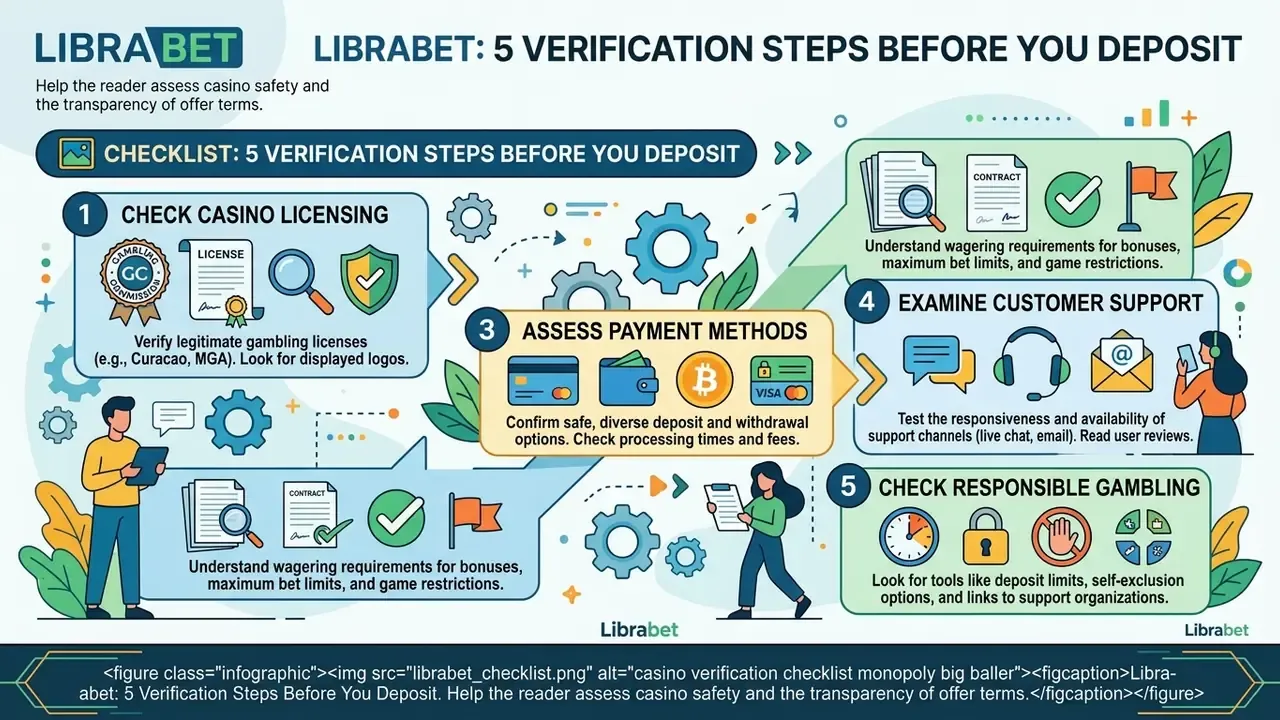
Before You Play: Five Checks That Actually Matter
Most players open a live monopoly casino table first and read the rules later. Reverse that order and you save money. Five checks, two minutes:
- Licence, verified at the source. Find the licence number in the site footer, then look it up in the regulator's own register. A badge image proves nothing on its own.
- Game contribution to bonus wagering. Live dealer titles very often count 0-10%. That single line decides whether a welcome offer is usable here at all.
- Withdrawal rules in INR. Minimum payout, processing time, and whether UPI, IMPS or NetBanking is actually available to your bank.
- KYC before the first win. Upload documents early. Verification queues are the most common reason a "fast withdrawal" turns slow.
- Your own stop point. Decide the loss limit and the session clock before the 12-second betting window starts eating your attention.
That is the compliance-first frame for everything below. Now the mechanics.
What Is MONOPOLY Big Baller
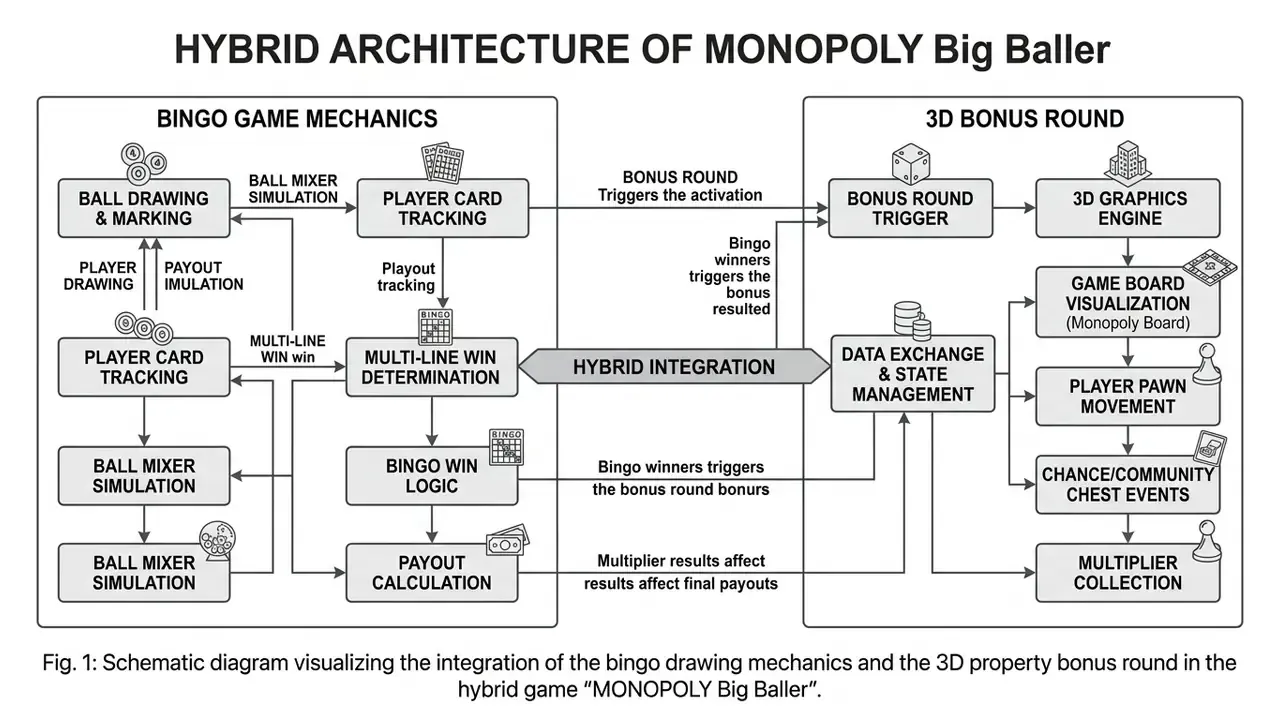
MONOPOLY Big Baller is a high-volatility live casino game show created by Evolution Gaming that merges an automated bingo-style lottery draw with the interactive virtual board from the classic MONOPOLY board game. Launched in August 2022 under official licence from Hasbro, the title replaces traditional game wheels with a lottron drum containing 60 numbered balls, from which 20 balls are drawn in every round (Evolution Gaming Announcement, 2022).
"MONOPOLY Big Baller combines bingo mechanics with a live show format, scaling to thousands of simultaneous participants without losing engagement." Evolution Gaming, comparison of MONOPOLY Big Baller with traditional live MONOPOLY (2022). https://www.evolution.com/news/evolution-launches-monopoly-live-in-the-u.s/
Players wager on up to four 5×5 bingo cards alongside two dedicated bonus cards ("3 ROLLS" and "5 ROLLS"), aiming to complete horizontal, vertical, or diagonal lines that pay fixed base multiples boosted by standard, line, and global multipliers.

The monopoly game is hosted live from a stylised riverboat studio by a real dealer, working next to an augmented-reality version of Mr. MONOPOLY. According to official game documentation, the headline theoretical Return to Player (RTP) is 96.10% on main Free Space and Chance cards, while the specialised "3 ROLLS" and "5 ROLLS" side bets return slightly less, at 95.80% and 95.20% respectively (Loto-Québec MONOPOLY Big Baller Game Rules, 2025).
Worth pausing on that gap. The bonus cards look like the exciting part of the game, and they are, but they also carry the weaker mathematical return. That trade-off runs through every strategy section below.
MONOPOLY Big Baller vs MONOPOLY Live: Key Differences
MONOPOLY Big Baller differs from monopoly live at the level of the random number generator (RNG) engine itself. A 54-segment spinning wheel gives way to a 60-ball lottery draw that resolves many bingo card lines at once. Where MONOPOLY Live opens the 3D board when a physical wheel stops on "2 ROLLS" or "4 ROLLS", Big Baller opens it when every unique number on your "3 ROLLS" card (3 numbers) or "5 ROLLS" card (4 numbers) is matched inside the 20-ball draw.
| Game parameter | MONOPOLY Big Baller | MONOPOLY Live |
|---|---|---|
| Core mechanic | 20 balls drawn from 60 (5×5 bingo cards) | Spin of a 54-segment money wheel |
| Bonus entry | Filling all numbers on the 3 ROLLS / 5 ROLLS cards | Wheel stopping on the 2 ROLLS / 4 ROLLS segment |
| Headline base RTP | 96.10% (main card) | 96.23% (segment "1") |
| Bonus volatility | High (3 and 5 dice rolls) | Very high (2 and 4 dice rolls) |
| Multiplier structure | Composite (Standard, Line, Global) | CHANCE segment / wheel multiplier |
| Simultaneous positions | Up to 6 (4 cards + 2 bonus cards) | Multiple wheel segments |
Editorial observation (updated). While reviewing live show mechanics for India-facing casino portals, our editorial team watched consecutive rounds of both titles side by side, two screens, same evening. The pattern we kept noticing, and one you can verify yourself on public trackers, is simple: MONOPOLY Live delivers discrete single-outcome spins with longer gaps between meaningful hits, while Big Baller produces rapid multi-line progress with every ball that drops. The result is a higher frequency of small line payouts, which smooths the feel of a session. To be clear, that is an editorial impression and not a controlled statistical study. For verifiable hit-frequency numbers, lean on the tracker data cited later in this guide rather than on any single observation window, including ours.
How the Live Format with Host and AR Mr. MONOPOLY Works
The live format streams continuously from Evolution's specialised European and US studios, mixing a human dealer with real-time AR graphics. The host manages the camera flow, calls out drawn ball numbers, and answers players in live chat. Meanwhile the animated mr monopoly stands beside the ball drum, pulls a mechanical lever to hand out card multipliers, and walks the 3D board during bonus events.
The drum uses a finite sampling model: 20 balls are pulled from a sealed chamber of 60 numbered balls by pneumatic suction, without replacement. Each ball is optically scanned and synced with player interfaces worldwide, so matching numbers are crossed off active cards in real time. Because the session runs centrally, thousands of players take part at once with no turns and no queue. Performance holds up on mobile and desktop across reasonably fast networks, and no app download is needed: the table runs directly in a modern mobile browser.
How to Play MONOPOLY Big Baller: Cards, Bets and Round Flow
To play monopoly big baller, you pick a chip denomination during the 12-second betting window, spread stakes across one to four main cards, set each card as either Free Space or Chance, and optionally back the "3 ROLLS" and "5 ROLLS" bonus cards. When betting closes, numbers between 1 and 60 populate every selected 5×5 card, Mr. MONOPOLY assigns random multipliers or extra free spaces, and the lottery machine draws 20 balls to complete winning lines.
Step-by-Step MONOPOLY Big Baller Round Flow
- Betting window. Choose a stake size (from ₹10 or €0.10) and activate 1 to 4 main 5×5 cards, plus the optional "3 ROLLS" and "5 ROLLS" bonus spots. Betting time is roughly 12 seconds, which is shorter than it sounds when you are configuring six positions.
- Card setup. Each card is toggled into Free Space mode (pre-marked centre cell) or Chance mode (guaranteed multiplier in the centre cell).
- Grid and multiplier generation. The system fills every card with random numbers from 1 to 60. Mr. MONOPOLY pulls the lever to place random daubs (free spaces) and multipliers (Standard, Line, Global).
- The 20-ball draw. The lottron extracts 20 balls out of 60. Matching numbers are daubed automatically on all your active cards by computer vision.
- Line and payout resolution. Completed horizontal, vertical and diagonal lines are paid, with every accumulated multiplier applied on top.
- Bonus activation. If all numbers on the "3 ROLLS" or "5 ROLLS" card have been matched, play moves to the 3D MONOPOLY board bonus game.
Bingo Card Numbers and Card Selection
Each main bingo card carries a 5×5 grid of 25 cells, filled with randomised numbers from the 1-60 pool. Before the round starts, you choose between two card states:
- Free Space Card. The central cell is marked as already drawn before the ball drop begins. That cuts the requirement for the four intersecting lines from five numbers to four, which lifts hit frequency, with standard line payouts running from 2:1 to 39:1 (SNAI Official iGaming Guide, 2024).
- Chance Card. The central cell holds a guaranteed multiplier instead of a free mark. Lines still need all five numbers, but any completed line crossing that centre multiplier pays far more, from 2:1 up to 199:1 before secondary global multipliers apply.
"RTP is 95.80% for the 3 Rolls bet and 95.20% for the 5 Rolls bet, reflecting the higher dispersion of bonus positions." Loto-Québec MONOPOLY Big Baller Game Rules (2025). https://www.lotoquebec.com
The card numbers are generated by the system, and every player at the table sees the same drawn balls. So there is no "number picking" skill here at all. No hot numbers, no cold numbers, no lucky grid. Your only real decisions are how many cards you play and which card type you play.
Bingo Card Odds: Line Probability and the Break-Even Point
Most newcomers overestimate how often a bingo line actually completes. A 5×5 card holds exactly 12 possible five-number winning lines: five horizontals, five verticals and two diagonals. Each behaves like a separate lottery ticket that pays only if its precise combination shows up in the draw.
- In a game that draws 20 balls out of 60, the chance that one specific five-number combination is fully covered is roughly 0.40%.
- Across all 12 combinations on a single card, the probability of completing at least one line is therefore about 12 × 0.40% = 4.80% per card.
- Free spaces improve this in a meaningful way: a marked centre cell turns the four lines crossing the middle into four-number requirements, and Mr. MONOPOLY may scatter extra daubs across any card after betting closes.
The break-even rule of four cards. Play all four main cards and you can expect roughly one line win every four rounds. Since the standard line payout is 3:1, that single win has to be boosted to a combined 16x or more (measured against one card stake) simply to return the four rounds of stakes you paid across four cards. Put plainly: without multipliers or bonus rounds, base-game line wins alone are structurally a losing proposition. The multipliers and the 3D board are where the mathematical value of this game actually sits.
One more detail that reframes the whole betting plan. The probability of triggering the bonus round with either bonus card is broadly comparable to the probability of landing a line win on one single bingo card. That is exactly why the 3 ROLLS and 5 ROLLS positions deserve real attention rather than being treated as decoration.
Optimal Card Combination Strategies
You may play 0, 1, 2, 3 or 4 main cards, in any mix of Free Space and Chance:
- 4 Free Space | 0 Chance
- 3 Free Space | 1 Chance
- 2 Free Space | 2 Chance
- 1 Free Space | 3 Chance
- 0 Free Space | 4 Chance
Three practical setups cover almost every budget and risk appetite.
- "Balance and bankroll protection": 3 Free Space + 1 Chance + 3/5 ROLLS
- Composition:three Free Space cards, one Chance card, plus both bonus spots (3 ROLLS and 5 ROLLS).
- Why:Free Space cards deliver more frequent small line payouts thanks to the free centre cell, partially covering round-by-round costs while you wait for the bonus game to trigger. The single Chance card keeps some upside alive in the base round.
- Volatility:Medium. Best suited to sessions of 50 rounds or more, with a bankroll of at least 40-60 round stakes.
- "Multiplier hunting": 1 Free Space + 3 Chance + 5 ROLLS
- Composition:three Chance cards for the highest payout ceiling (up to 199:1 per line, before Global multipliers), one Free Space card for hit frequency, and the 5 ROLLS bonus bet with its five dice rolls.
- Why:Chance multipliers stack multiplicatively on the same card, so a monopoly big baller big win is far more likely to originate here than on Free Space cards.
- Volatility:High. Expect long dry stretches, sometimes 30 rounds with nothing. Only viable with strict loss limits set in advance.
- "Minimum exposure": 1 Free Space + 3 ROLLS
- Composition:one Free Space card and the cheaper 3 ROLLS bonus bet, which needs only three unique numbers and therefore triggers more often than 5 ROLLS.
- Why:the smallest possible per-round cost while both win routes, line payouts and board access, stay open.
- Volatility:Low to medium in money terms, mostly because total exposure per round is so small.
A key detail many guides skip: the 3 ROLLS and 5 ROLLS cards can also receive free spaces and multipliers from Mr. MONOPOLY. A free space landing on the 5 ROLLS card drops its requirement from four matched numbers to three, briefly giving it the same trigger difficulty as the 3 ROLLS card while keeping five dice rolls of upside. Nice when it happens. You cannot plan around it.
Bets and Number of Cards in One Round
You can activate up to six distinct betting positions in a single round: four main bingo cards plus two bonus cards. Table limits usually run from a minimum of ₹10 (€0.10 or £0.10) up to ₹100,000 (€1,000-€4,000) per card, depending on operator configuration, all sitting under a maximum win cap of 500,000 currency units (or €500,000) per round. Some official rule documents list narrower ranges, for example €0.20 to €1,000, so confirm the limits panel on the specific table you join before you commit chips.
Total round exposure is the number that matters for risk. Four Chance cards at once raise your stake per round by 400% without changing the underlying independent probabilities of any single card. Mathematically, playing one card for four rounds and four cards in one round come to the same expected cost; the difference is variance and how fast the bankroll moves. The real constraint is bankroll size and how long you want the session to last.
Balls, Numbers and Dice Rolls During the Game
During the draw phase, exactly 20 balls leave the 60-ball chamber, without replacement. Matching numbers are daubed instantly on player cards through automated computer vision, and the interface shows both drawn balls and remaining ones: red balls match numbers you hold, grey balls match nothing on your cards. Winning outcomes depend strictly on completing full five-symbol lines, horizontally, vertically or diagonally.
If a bonus card is fully cleared during those 20 balls ("3 ROLLS" needs three unique hits, "5 ROLLS" needs four), the main game closes and the dealer moves to the physical dice roller for the 3D MONOPOLY board segment.
Bonus Mechanics of MONOPOLY Big Baller
The bonus mechanics split into two layers: pre-draw card enhancements (Free Space marks, Chance multipliers, line multipliers and global card boosters) and the 3D MONOPOLY Bonus Game reached through the two side cards. Together these modifiers can lift a standard 3:1 line payout into the hundreds of times your stake.
Comparative overview of MONOPOLY Big Baller bonus mechanics
| Bonus mechanic | Activation condition | Role in the round | Effect on multipliers and payouts |
|---|---|---|---|
| Free Space Card | Selected by the player before the round | Automatically daubs the centre cell of the card | Raises line-completion frequency; payout range 2:1 to 39:1 |
| Chance Card | Selected by the player before the round | Guarantees a multiplier in the centre cell | Raises volatility; payout range 2:1 to 199:1 |
| Standard Multiplier | Randomly awarded by Mr. MONOPOLY (10x or 20x) | Attached to a specific number on the card | Multiplies the payout of any line containing that number by 10 or 20 |
| Line Multiplier | Randomly awarded by Mr. MONOPOLY (20x or 50x) | Applies to a full row, column or diagonal | Multiplies the payout of that completed line by 20 or 50 |
| Global Multiplier | Randomly awarded by Mr. MONOPOLY (x2 or x3) | Attached to a number; activates when that ball is drawn | Multiplies the TOTAL win across ALL lines on that card by 2 or 3 |
| 3 ROLLS Bonus | All 3 unique numbers on the "3 ROLLS" card are drawn | Transition to the 3D board with 3 physical dice rolls | Accumulates property multipliers on the MONOPOLY board |
| 5 ROLLS Bonus | All 4 unique numbers on the "5 ROLLS" card are drawn | Transition to the 3D board with 5 physical dice rolls | Highest win potential thanks to the largest number of moves |
Free Space Card and Chance Card in Practice
Before numbers are assigned, you toggle each active card between Free Space and Chance. A Free Space card lowers the line completion threshold: the central cell is marked at once, and extra free spaces may be distributed randomly across other cells once betting closes.
A Chance card gives up that free centre mark in exchange for payout power. The central cell receives a guaranteed multiplier, for instance 10x, 20x, or a line multiplier, which raises the ceiling every time an intersecting line completes. The trade-off is honest and measurable: Free Space tops out at 39:1 per line, Chance at 199:1. Still, a Chance multiplier can also land as low as 2x, so calling it the "stronger" card is too simple.
Chance Multiplier Types and How They Stack
Mr. MONOPOLY can award three categories of chance multiplier types during the pre-draw setup phase:
- Standard Multipliers. Assigned to single numbers, worth 10x or 20x. If a completed winning line contains that number, the line payout is multiplied accordingly.
- Line Multipliers. Assigned to a whole row, column or diagonal, worth 20x or 50x. Complete that specific line and its payout is multiplied by the stated factor.
- Global Multipliers. Assigned as x2 or x3 modifiers attached to specific numbers. If the linked ball is drawn, the total payout of all winning lines on that card is multiplied by x2 or x3. Global multipliers also multiply everything else, Line and Standard included.
Where several multiplier types land on the same completed line, their values stack multiplicatively rather than adding up. Example: a 3:1 base line holding a 10x Standard multiplier, a 20x Line multiplier and a x2 Global multiplier gives 3 × 10 × 20 × 2 = 1,200x the card stake, subject to the 500,000-unit round cap.
3 ROLLS, 5 ROLLS and the MONOPOLY Bonus Game
Entry to the bonus game runs entirely through the two dedicated side bets:
- 3 ROLLS Card. Receives 3 random numbers. Match all three drawn balls and you get 3 rolls of the dice on the 3D board.
- 5 ROLLS Card. Receives 4 random numbers. Match all four drawn balls and you get 5 rolls of the dice.
Trigger both "3 ROLLS" and "5 ROLLS" in the same round and the system runs both bonus rounds one after the other, keeping the full roll allotment of each trigger.
"Across 34,000 rounds: the 3 Rolls bonus triggered in 3.10% of rounds, 5 Rolls in 1.32%; combined frequency of at least one bonus was 4.40%." Tracksino Real-Time iGaming Tracker (2026). https://www.tracksino.com/monopoly-big-baller
Translating percentages into session reality. Long-run figures of 3-5% are hard to feel while you are sitting at the table, so here is the practical version: a bonus round lands on average once every 20-25 game rounds. One round cycles in roughly 40 to 50 seconds, which works out to about one bonus every 15 to 20 minutes of play. Budget with that in mind. A bankroll sized for 30-40 rounds minimum is the realistic floor if you want to still be seated, with an active bonus bet, on the round when the board finally opens.
The MONOPOLY Board: How the Bonus Round Plays Out
The monopoly board bonus round runs on a 3D virtual board with 40 standard spaces: 22 street properties, 4 railroads, 2 utilities, Chance, Community Chest, Tax tiles, and the four corners (GO, Jail, Free Parking, Go to Jail). Mr. MONOPOLY starts at "GO" and moves according to the sum of two physical dice rolled in the live studio.

Before the dice start rolling, virtual houses and hotels are built at random across property tiles, pushing their baseline multiplier values (which begin between 1x and 100x) up to a ceiling of 500x per tile (Tracksino Real-Time iGaming Tracker, 2026).
Spaces on the Board and Dice Rolls
Movement is decided by standard physical dice rolls:
- Property spaces. Landing on a street, railroad or utility adds its accumulated multiplier to your bonus win pool.
- Passing GO. If Mr. MONOPOLY completes a full circuit and passes "GO", every property multiplier on the board is permanently doubled for the remaining rolls.
- Doubles. Rolling a double on the two dice grants one extra free roll, which extends the bonus sequence and, occasionally, turns a modest bonus into the memorable kind.
Low / Mid / High Tier Dice Rolls
Not every roll carries the same value. Because dice sums cluster around 7, the distance Mr. MONOPOLY travels, and therefore which price bands he can reach, follows a predictable shape. Theoretical probabilities for two dice, next to an observed sample of 257 bonus rolls published by a public tracker, break down like this:
| Tier | Dice sums | Theoretical share | Observed sample (257 rolls) | Typical effect |
|---|---|---|---|---|
| Low Tier | 2, 3, 12 | ~11.1% | ~13.6% | Minimal board progress; multipliers up to roughly 15x |
| Mid Tier | 4, 5, 9, 10, 11 | ~44.4% | ~44.5% | Steady mid-range income, typically 20x to 60x |
| High Tier | 6, 7, 8 | ~44.4% | ~41.9% | Fastest circuits, more GO crossings, access to expensive Dark Blue streets at 100x and above |
Two takeaways. First, High and Mid tier sums dominate the distribution, which is why long bonus chains built on doubles produce the largest outcomes. Second, the observed sample drifts slightly from theory in both directions, which is ordinary small-sample variance rather than evidence of bias. Over thousands of rolls, tracker distributions settle onto the theoretical curve.
Income Taxes, Winnings and the End of the Bonus Game
Special board spaces change your accumulated bonus winnings:
- Income Tax and Super Tax. Income Tax trims total accumulated bonus winnings by 10%, Super Tax by 20%. These deductions apply only to accrued bonus multipliers, never to your account balance, and they are in-game taxes with no relationship whatsoever to real-world taxation.
- Chance and Community Chest. Award either a direct cash prize multiplier, or a movement penalty or bonus, or in some cases a fee taken from current bonus winnings.
- Jail Space. Sent to Jail, Mr. MONOPOLY is stuck and collects nothing; a double roll on a later turn is needed to get out and resume movement. Ending the bonus while still in Jail does not remove multipliers already banked.
The bonus round ends when all assigned rolls, plus any earned doubles, are used up. The final accumulated multiplier is applied to your initial "3 ROLLS" or "5 ROLLS" stake and paid alongside any base-game line wins from the same round.
Odds, Multipliers and MONOPOLY Big Baller Big Wins
The mathematical distribution here is built around high volatility: small base-line wins recur often, while extreme multiplier payouts arrive as statistical outliers. According to Tracksino Real-Time iGaming Tracker (2026), whose dataset covers roughly 34,000 logged live rounds (tracksino.com/monopoly-big-baller), real-world hit frequencies for the major win brackets look as follows:
| Multiplier bracket | Share of outcomes | Empirical odds | Outcome profile |
|---|---|---|---|
| 10x to 30x | ~85.0% of all bonuses | High frequency | The standard bonus-round result |
| 100x to 150x | 0.23% of all rounds | ~1 in 425 rounds | Moderate multiplier spike |
| 200x to 299x | 0.05% of all rounds | ~1 in 1,190 rounds | Big win territory |
| 300x to 499x | 0.012% of all rounds | ~1 in 8,500 rounds | Rare random peak |
| 500x and above | 0.010% of all rounds | ~1 in 11,000 rounds | Ultra-rare super bonus |
For scale: public trackers log several 500x-class results per month across all tables. You only take part in one if you happen to hold an active bonus bet in that exact round, which is a reminder about participation, not a reason to over-bet.
"Technical standards for online casinos require a cryptographically strong RNG: outcomes must be unpredictable, unbiased and resistant to reverse engineering." Connecticut Online Casino and Keno Technical Standards, referenced alongside Michigan Gaming Control Board regulations (2026). https://www.michigan.gov/mgcb
Because certified RNG and the sealed 20-from-60 draw make every round mathematically independent, no bracket ever becomes "due" after a drought. The table above describes a long-run distribution. It is not a schedule.
⚠️ RESPONSIBLE GAMBLING ALERT (18+) Live casino game shows are built purely for entertainment and run on certified random number generation. Past round outcomes, multiplier streaks and tracker histories have zero predictive power over future draws. Never treat MONOPOLY Big Baller as an investment, an income source or a way to recover a loss. Decide in advance how much you are prepared to lose, expect to lose more rounds than you win, set session budget and time limits before you play, and stop immediately if gambling starts causing financial or emotional stress. Never gamble with borrowed money, and never chase losses. If it stops being fun, stop playing and contact a local support service.
MONOPOLY Big Baller Results Today: Where to Watch and How to Read Them
Once you understand where multipliers come from and how often bonuses trigger, the next question follows naturally: how do you verify any of it independently? That is what public result trackers are for. The game interface itself shows only the biggest multiplier of the day, with no history panel, no "rounds since last bonus" counter and no multiplier log.
Players searching for "monopoly big baller results today" or a monopoly today result can consult third-party live tracker platforms (Tracksino, TrackerSino, and dedicated Big Baller history sites) that record round IDs, drawn balls, bonus triggers, dice-roll distributions, top multipliers and estimated short-term payout percentages in real time. These portals pull public feed data from the live streams, which gives transparent visibility into session history, filters by date and operator, CSV export, and analytics charts. Some also stream monopoly big baller results today live next to the numbers, so you can follow a table without staking anything.
Example structure of a MONOPOLY Big Baller results table (results today)
| Time (UTC) | Round ID | Drawn balls (20 of 60) | Bonus | Bonus type | Top multiplier | Total payout |
|---|---|---|---|---|---|---|
| 2026-06-22 10:12:00 | #MBR-884101 | 04, 07, 12, 15, 18, 22, 25, 29, 31, 34, 38, 41, 45, 48, 50, 52, 55, 57, 58, 60 | Yes | 3 ROLLS | 45x | 1.12x |
| 2026-06-22 10:12:45 | #MBR-884102 | 01, 03, 08, 10, 14, 17, 20, 23, 27, 30, 33, 36, 39, 42, 44, 47, 49, 53, 56, 59 | No | n/a | 12x | 0.78x |
| 2026-06-22 10:13:30 | #MBR-884103 | 02, 05, 09, 11, 16, 19, 21, 24, 26, 28, 32, 35, 37, 40, 43, 46, 51, 54, 58, 60 | Yes | 5 ROLLS | 310x | 2.45x |
Table updated: 2026-06-22. Figures illustrate how real-time result distributions are presented, not a promise of returns.
How to Interpret Historical Statistics Correctly
When you read live tracker tables, keep the Gambler's Fallacy in view. Seeing that the "5 ROLLS" bonus has not landed for 100 consecutive rounds does not raise its probability of landing on round 101. Every ball draw is an independent event with fixed odds, produced by certified RNG and audited by regulators.
Trackers serve three legitimate purposes: verifying game fairness across large samples, understanding macro-volatility before you commit a bankroll, and sanity-checking marketing claims about "frequent" bonuses. They are not forecasting instruments. Any betting system built on a "rounds since last bonus" counter carries an expected value identical to random play, minus the house edge. Monthly summaries and biggest-win lists are interesting reading; they are not a signal to increase stakes.
How to Access MONOPOLY Big Baller and Evaluate a Casino Offer
Disclaimer. The information below is general and does not replace professional advice. Bonus conditions, licensing requirements and tax obligations vary by jurisdiction and change often. Verify current rules on the operator's official website, and for tax or legal questions consult a qualified specialist in your country, before depositing funds.
To reach MONOPOLY Big Baller safely, choose an officially licensed online casino that hosts Evolution Gaming games, accepts players from your jurisdiction, runs smoothly in a mobile browser, and offers localised deposit and withdrawal options such as UPI, NetBanking and IMPS for India.

📋 Checklist: Verifying the Offer and Casino Terms
- Operator licence verification. Make sure the monopoly casino displays a valid, verifiable licence from a recognised regulator (MGA, Curaçao eGaming, the UK Gambling Commission, or a regional register). Check the licence number in the regulator's own registry rather than trusting a footer badge.
- Wagering requirements. Confirm whether live casino games count toward bonus wagering at all. Slots usually contribute 100%, while live dealer games often contribute just 0% to 10% (Michigan Gaming Control Board Regulations, 2026). Michigan's rules also require that all offer terms, including active and expiry periods, stay clearly accessible after the bonus is accepted.
- Maximum bet cap. Check the maximum bet allowed per round while bonus funds are active (often ₹400 or €5 per spin). Breaching it voids bonus accruals, and that is an easy mistake here: four cards plus two bonus spots can quietly push total exposure past the cap without you noticing.
- Withdrawal transparency and KYC. Look for clear withdrawal thresholds, processing timelines and document requirements, and check that payment options suit your region, for example direct INR payouts through UPI or IMPS with no hidden conversion charge. Complete KYC before you win, not after.
- Local legal context. Indian users should note that under the Promotion and Regulation of Online Gaming Act (2025) and the associated Rules (2026), frameworks around online money games remain strictly regulated (MeitY Notification, 2026). Verify regional compliance and local tax duties before playing any real-money product.
Wagering Calculation Example: What a Live Casino Bonus Really Costs
Bonus terms read generously until you convert them into turnover. Here is the arithmetic on a typical structure:
Scenario: ₹1,000 bonus, 30x wagering requirement, live dealer contribution 10%, 14-day expiry, max bet ₹400.
- Nominal wagering: ₹1,000 × 30 = ₹30,000 of qualifying turnover.
- Because live games count at only 10%, every ₹100 wagered in MONOPOLY Big Baller counts as ₹10.
- Real turnover required in the live game: ₹30,000 ÷ 0.10 = ₹300,000.
- At a ₹100 total stake per round, that is 3,000 rounds, roughly 35 to 40 hours of continuous play.
- At 96.10% RTP, the expected theoretical cost of that turnover is ₹300,000 × 3.9% ≈ ₹11,700, far more than the ₹1,000 bonus.
Conclusion. If a bonus counts live games at 10% or 0%, it is effectively a slots bonus wearing a live casino headline. Play MONOPOLY Big Baller with real-money balance instead, and treat live-eligible promotions such as cashback, rakeback or tournament leaderboards as the more sensible reward route for this game type. No pressure either way: skipping the bonus entirely is a perfectly reasonable choice.
India: Legality, Payments and Taxes
Indian players make up one of the largest audiences for this title, and the MONOPOLY board is widely known locally as "Business", so the regional layer deserves its own section.
| Aspect | What players should know |
|---|---|
| Federal framework | The Promotion and Regulation of Online Gaming Act (2025) and the Rules notified by MeitY (2026) tightly regulate online money games. Compliance status can shift quickly, so verify the current position before depositing (MeitY Notification, 2026). |
| State-level variation | Gambling is largely a state subject. Goa and Sikkim have historically permitted regulated formats, while states such as Telangana and Andhra Pradesh have enacted broad prohibitions on online money gaming. Your state of residence, not the operator's location, determines your exposure. |
| Payments | Most India-facing operators support INR deposits and withdrawals through UPI, IMPS and NetBanking. Check for hidden currency-conversion spreads if the table itself is denominated in EUR. |
| Currency and stakes | Stakes typically start around ₹10 per card. With four cards plus two bonus spots, a "minimum" round can still cost ₹60, so factor that into bankroll planning. |
| Taxation | Indian income tax law applies a flat rate with TDS on net winnings from online games (Section 194BA of the Income Tax Act). Rates, thresholds and reporting duties change, so consult a qualified tax professional about your situation. |
Disclaimer (legal and financial). Nothing in this section is legal, tax or financial advice. Online gambling legality in India varies by state and remains subject to ongoing legislative and judicial change. Confirm your local position with a qualified professional before playing real-money products.
Multiplier Stack Calculator (Development Spec)
Because these multipliers compound rather than add, most players underestimate outcomes until they see the arithmetic laid out. Below is a ready specification for an on-page interactive module:
[MODULE: MONOPOLY Big Baller multiplier stack calculator]Inputs: stake per card (₹ or €) × base line payout (default 3x) × Standard multiplier (none / 10x / 20x) × Line multiplier (none / 20x / 50x) × Global multiplier (none / x2 / x3) × number of completed lines (1 to 12). Logic: total = stake × base × standard × line × global × lines, with a hard ceiling at 500,000 currency units per round. Output: final payout, effective total multiplier, and a flag when the official cap truncates the theoretical result. UX note: display a permanent caption stating that the calculator models payout mechanics only and does not estimate the probability of any combination occurring.
FAQ
What is the minimum bet, and can I play in rupees?
How often does the bonus round trigger?
Which is better: Free Space or Chance cards?
What is the maximum win?
Can a stats tracker help me win?
Can I play on mobile?
Where to Go From Here
You now know the three numbers that define this game: 96.10% base RTP, a 4.80% line chance per card, and a bonus roughly every 20 to 25 rounds. Read the licence, read the wagering line, then decide calmly.
If the terms are not clear, the honest answer is to walk away and check another operator. If they are clear, set your limit first, treat the stake as the price of entertainment, and never as expected income.